
Index

 ELECTRONIC LABORATORY NOTEBOOK
ELN is the central module of this program. ELN serves to keep user records
and related data files in an automatically organized way, stamped with date-time and unique ID.
New records are added by providing at least a short title:
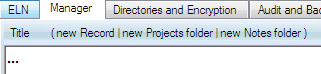 |
and pressing the new page button:
 |
New page is issued, date-stamped, formatted and integrated into the notebook automatically.
Records can be fully edited later and the details and results filled in.
There are two types of records: Projects and Notes. Projects are equivalent to paper
folders with day-to-day records on a particular research project. Notes are organized thematically
rather than by date-time and serve well for organizing laboratory protocols, PDFs, thematic pages,
such as "PyMol commands and usage", "Linux tuning"

Before using ELN, it is important to decide if ELN will be encrypted or unencrypted.
(it is possible to transfer ELN between these types of uses if needed later)
Instructions below apply to unencrypted ELN.
The use of encrypted ELN is outlined in the TrueCrypt section.
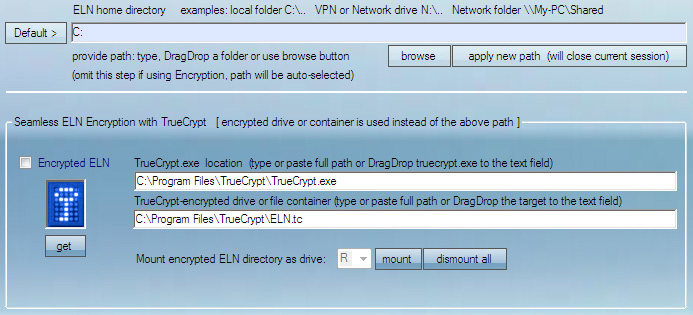
 TO BEGIN: SET AN ELN WORKING DIRECTORY
Working directory is the home location of all future records in ELN.
Do not check the Encrypted ELN check box unless you plan to set up and use encryption.
CREATING NEW PROJECTS AND NOTES FOLDERS
In ELN Manager, type a project name in the "Title" box. Click "add" button  to create a new Project (or new Notes folder).

ADDING NEW PAGES TO PROJECTS AND NOTES
To add a new page to a Project or a Note,
(1) Select a Project name or a Note name in the list box below the folder buttons.
(2) Type the title of a new page in the "Title" box.
(3) In the "Description" box below, type a detailed description, in plain text,
or a short description (more description can be added later to the finished ELN page) Insert a Template, if necessary:

Note that some templates have format
===[( tag )]===
for automatic processing. This format should not be altered. One should write only in lines between these tags.
Templates can be freely edited and custom templates can be made
by selecting >edit_templates
After steps 1-3 are completed, a new page can be created by clicking the add page button .
The ID number on the last created page will be shown as "Snapshot ID":
Remarks The VIEW
  button can be used to open the most recent page in selected Projects or Notes. Spell checking is built-in and is always enabled in the Description (or Content) window.

If a correct word is highlighted in "Page text" field, it can be added to the dictionary. Although this program is recommended for project browsing, Internet Explorer,
Firefox or other web browsers can be used to view all contents. Yes-No confirmation message boxes for projects, notes and pages can be hidden.
Go to Menu->Fonts and Styles and create a new text file named "noboxes.txt". SAVING PROGRAM's STATE IN PROJECTS
Every time a new project page is created, a *.dca file is auto saved in the folder of this page. The *.dca file contains a snapshot of the Biochem Lab Solutions ELN state (values in text boxes).
To manually save a snapshot of the program's entries, the  button can be used.
This button saves the *.dca file to the most recent project page created.
The ID of the most recent page is shown as the "Snapshot ID".
Each time the "BOX" button is clicked, it is disabled to disallow overwriting existing *.dca files. To re-enable this button, type a new title in the "Title (opt)" text box found in the Solutions module.